
Creators and Monsters
"Who hurt you?" Musings about Frankenstein

Beware of spoilers
Elizabeth: Why is he chained here?
Victor: For his own safety and for mine…It doesn’t know any better.
Elizabeth: But you do.
I am embarrassed to admit that I have only explored the Frankenstein story now at age 46 and only through Guillermo del Toro’s film adaptation. I have yet to read Mary Shelley’s novel. The story’s premise terrified me as a child, and even as I aged, I never took interest in the implausible, ridiculous science of man creating human.
Until now.
I am captivated. The Gothic aesthetics, the alchemy, the necromancy, the mysticism, the symbol within symbol, the beauty in death, and deepest questions of life. How could I have missed this story all these years? How could I have missed such a colossal critique of imperial and colonial extraction, of industry, capital, phrenology, slavery, of the Enlightenment’s eugenics and rational objectivity, of the era’s racist, ableist, and misogynist views of intelligence? How could I have missed this massive, brilliant exposé of patriarchy’s cruelty committed by lords who rule by imposition, authored by an 18 year-old after losing her mother and baby?
I missed the story because it wasn’t yet time for me to know it. There is no forcing things into being.
My Monster
The Creature: I am obscene to you, but to myself I simply am.
For about a month now, my own monstrous Leviathan, as I originally called her, has returned to the forefront of my psyche for re-examination, or more likely, for more love from me. Mary Shelley’s monster seems to have something to say to mine.
Eight years ago I discovered my sea monster, this Kraken, Eldritch Horror-type creature, when she encircled my sinking ship. As her tentacles slithered around the ship’s edges and coiled up my chest where I stood above the ship’s cracking stone figurehead, my Leviathan raised her gruesome face above the water’s surface, reaching eye level to me.

With every ounce of courage I could muster, I chose to look into her eyes. A burst of both horror and compassion moved me to realize that she was me. A lifetime of rejecting her and everything she represented—feminine power, anger, autonomy, disobedience, transgression, harm, yearning, and destruction—had resulted in her growth. The more I refused her, the larger she became. The more I speared her away, the more fiercely she returned. The more I contorted myself into something that was decidedly not her, the louder she screamed.
My ego-preserving tactics of image maintenance were no longer working. For so long being good was safer than being true, but the truth of my Leviathan’s screeches could no longer be ignored. My attempts to claim that “This isn’t me” because “I’m The Good Girl who has spent a lifetime in obedience to God and man” weren’t fooling anyone. Everyone around could see my Leviathan emerging from her watery dungeon. My most destructive, murderous, vile, hideous, and unlovable version of myself had been stitched together from many traumatized dead bodies living in the closet of my psyche. Then one night, a lightning bolt’s assault animated her into action.
Although it was I who stood at the bow of my sinking ship, I was also the creature in the water taking it down. My lesson at the time? I am whole. My most out-of-control self was also my most determined one. My most destructive self was also my most passionate, poetic, and most creative self. My most yielding self was also my most powerful, most autonomous, most brave, most true self. There is no separation when living in the fullness of truth.
Thanks to therapy, I learned that a lifetime of repressing monsters means the monsters are in control. Turns out that keeping my Leviathan underwater kept me unaware of her movements under the surface. Turns out just saying she shouldn’t be there doesn’t mean she goes away. She might be obscene to others, but to herself, she just is. She was there because she was there. I just couldn’t see what she was doing behind my back - or underneath my ship.
Creator of Monsters: A Theology
Victor: Your heart is pure? I assure you it isn’t. I should know, I put it there.
Our theology claimed that Jesus had already washed away our monsters, so they shouldn’t exist at all. If our monsters did exist, it was because we were being the monsters God created us to be. Our flesh was sin you see, but being the sinful creatures God created wasn’t allowed. So, we asked for forgiveness for our monster’s existence and presumed that God’s forgiveness would send our monster away.
But it didn’t. The monster lurked below. Without realizing it, we suppressed and repressed the monster by saying: Sin no more. Abandon it. Imprison it. Punish it. Conquer it. Reject it. Pretend it’s not there. Just don’t think about it. Twist it. Call it by a different name. Ignore the truth. Put the monster in chains and hide him in the dungeon. Kill it.
Like Frankenstein’s creature, sin doesn’t just go away when you try to kill it. Truth never dies. What’s more horrifying than a reality from which you cannot run? When truth is suppressed, it regenerates. It persists. It becomes louder. It hunts you. It wants your attention. It takes control.
Is it any wonder that the people who espouse a faith of love and grace are part of the political group that is whitewashing history and committing abject horror onto immigrants, Black and Brown people, Indigenous people, poor people, Muslims, women, LGBTQ people, the disabled, children? Kidnapping, raping, imprisoning, and killing their neighbor? Defying the law? Pretending not to see the blood on their hands?
MAGA exists because evangelicals believe that their salvation requires them to be good, not whole. Conquer the sin. Kill the monster. At best, they want to correct and reform “the other” out there because they believe that with Jesus, the Victor over Monsters, they have reformed the hideous other within themselves. Rather than showing the other love, they’re supposed to change it, control it, get rid of it. But like Victor, by trying to reform their monster, they’ve become the monster.
del Toro’s adaptation brings the question of culpability to light, who is responsible for the monster’s monstrosity? Who should be blamed for the destruction, the traumatized child or the father who hurt him? The film shifts our scornful gaze from the created to his creator. Perhaps the one who fashioned his creation from what was already dead, shackled his creation, beat him into compliance, and tried to torture his creation in a fiery underworld all for the supposed greater good should be held accountable.
But the thing about this life is that we are the very thing we are trying to conquer. It’s just how it works. Victor’s younger brother William confesses that all along, he has feared Victor and his cruelty, dominance, self-righteousness, and arrogance, and says to him, “You are the monster.”
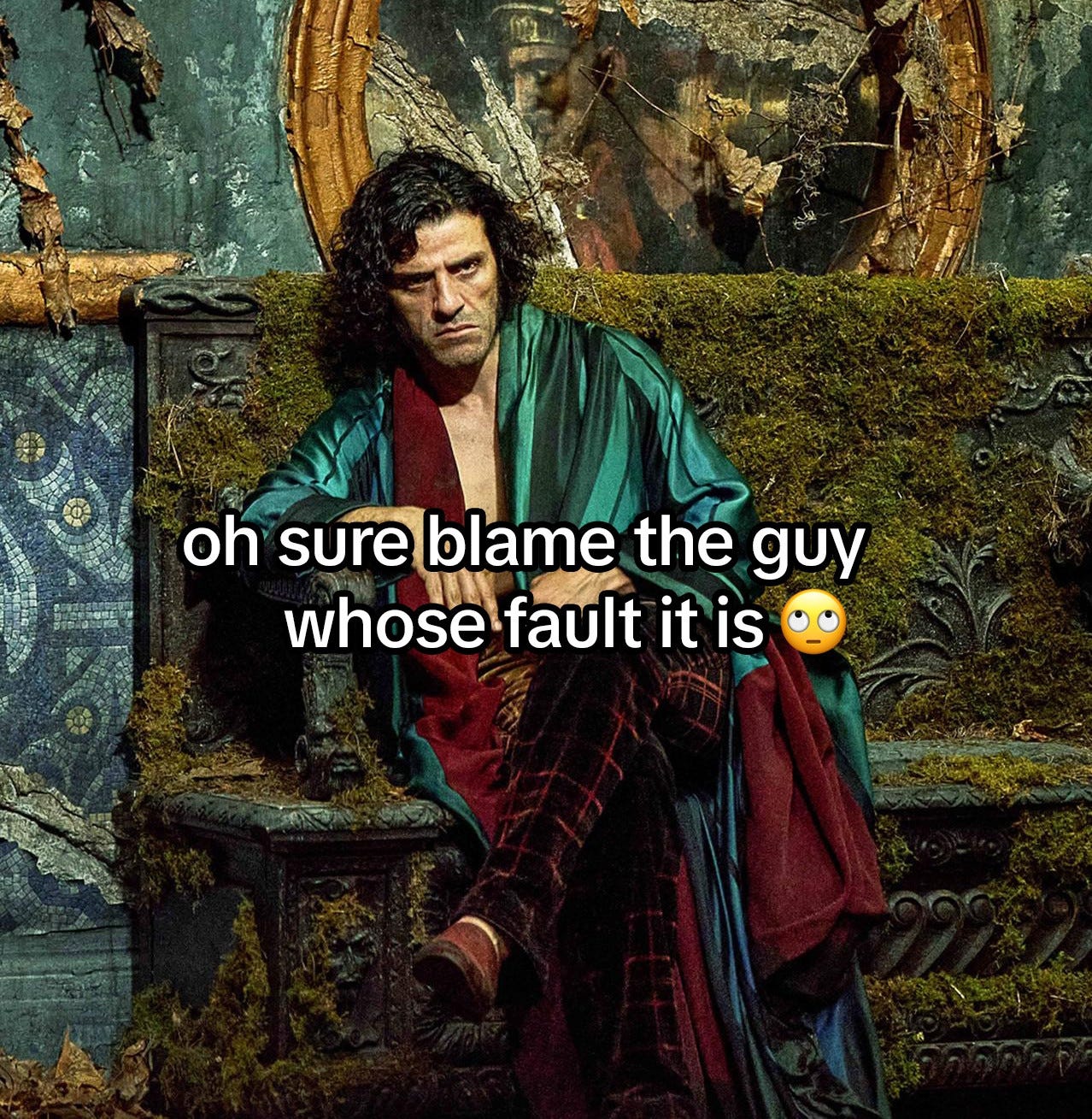
What a concept, holding a male creator responsible for imposing his intentions onto others’ bodies while claiming the other has free will. Imagine that, seeking accountability for the trauma men created by denying others’ consent. Wow, how insightful, blaming men for the destruction that ensues when they rule by force.
Playing Woman
Elizabeth: Only monsters play God.
Yes, the story of Frankenstein shows what happens when humans try to play God, but I’d like to suggest that Victor isn't trying to play God. He’s trying to play woman. To be fair, so is God.
In a CBS Sunday Morning interview, del Toro lists the Catholic themes in the film:
crucifixion, the crown of thorns, the wound in the side, resurrects after the third day of the battlefield, it’s full of that. And there is a meditation of the role of God and Jesus. If they are consubstantial, why did God send Jesus to be crucified and to die? What is he trying to find out?
According to del Toro’s old man friend of the creature, God was intrigued by death and suffering, so he sent his son to experience it. The kind, soft, old man then told the creature about how he experienced death and suffering. He wished he could forget the time he killed a man. Despite his belief in forgiveness, the old man wanted to rid himself of his monster. God’s forgiveness had not washed it away.
I like to think that God sent Jesus to be crucified because God and the men who created him are trying to find out what it’s like to be a woman. God in all his ethereal, immaterial, spiritual nature wanted to know what it’s like to bring life into physical existence. He wished he could feel the kicks and twists inside his being, the nausea, the connection, the contractions, basically the embodied labor required for bringing something into existence.
God sent Jesus because he wanted to know the material juxtapositions required for wholeness, secrets of the cosmos held in the feminine body. How else would God enter the holy of holies if not by entering a womb? Its darkness contains both the infinite existence of what was, the sacred present, and the infinite possibilities of what will be. A pregnant being is three in one, the trinity made manifest. She is consubstantial with what grows within her. Her darkness envelops life’s beginning and its end, the alpha and omega. She sits at death’s door to bring life into the world, her body broken and blood shed for you. You enter your new life through water, a baptism. God needed Jesus to show the world that salvation, soteria, delivery, comes from the feminine.
Victor in his maleness has no capacity to bear life, no capacity to use one’s body to nurture. He consumes milk to give him the feminine powers he needs to create, birth, and sustain life from his very own body. But like every male deity, Victor does not have the power of a human woman. So, he tries to contort himself into something he is not, a life-bearer. Instead of accepting himself as a mere fertilizer of the authoritative, selective seed already in the soil, he wants to be the fertilizer, the seed, and soil, taking all the glory for himself.
Instead of accepting himself for what he does and does not contribute to life’s reproduction, Victor treats women as the Medusa to be controlled, the threat to be mitigated. He created his own monster because he wanted control over his mother’s life. He did not have the capacity to feel the pangs of grief, to birth a life without her.
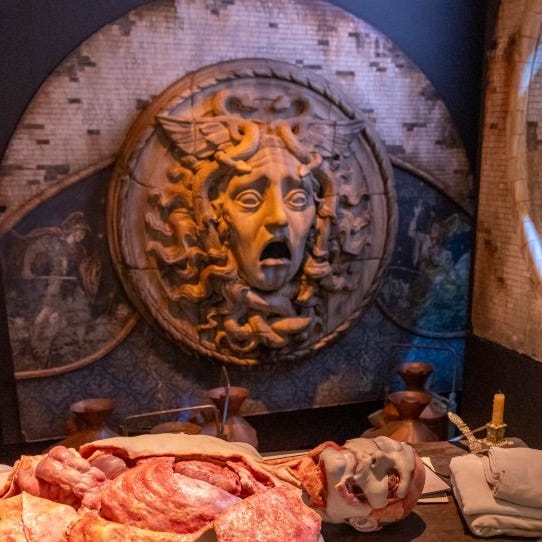
Victor, with his objective reason of The Enlightenment era, does not understand mutuality, interrelatedness, intuition, uncertainty, or mystery. He does not understand The Feminine. He only understands forcing something into being. Like modern colonialists, enslavers, theocrats, pronatalists, forced birthers, and entitled impregnators, Victor does not understand consent. To be fair, neither does the fundamentalist Christian god. He wants to be the life-giving hero, conquering death by threatening life, claiming to have all power, then demanding others’ subservience, obedience, and praise.
Simply put, Victor creates life because he wants the power of a woman. Victor has little understanding of the monster borne from dominance versus the life borne from mutual consent. Any god that claims he has all power, and his creation has none is just like Victor, ignorant of what it takes to honor the will of another.
The thing about true power is that power is only inherent, never imposed.
Many presume that power means affecting change, influencing someone, or controlling an outcome, just as Victor Frankenstein did. I would like to suggest that power as control is illusory power. Presuming we are powerful if we can make something happen means we have given our power to that thing.
Likewise, people who only feel powerful according to others’ responses or actions, whether approval, anger, submission, or praise, externalize their power. Trying to control what you have no business controlling means rendering yourself powerless because your sense of power is dependent upon someone else’s actions. When a parent only feels good about himself if his child aligns with him, that parent seeks utmost control over the child. Thus by controlling the child, the parent gives away his power to the child. Frankenstein gave his power to his creation.
The Master Is Enslaved
The Creature: You may be my creator, but from this day forward, I will be your master.
This is the paradox of relationships built on control: the master becomes bound to his slave. He knows he cannot exist without the slave because of the security the slave provides him, however illusory that security may be. As such, the master’s barbarism results from his own lack of freedom. This is why Freire stated that when the oppressed free themselves, they also free their oppressor. Marronage liberates the enslaved from the master’s gruesome brutality, and it liberates the masters from behaving as savage tyrants and fearful children.
The same is true of a male creator, whether Frankenstein or the fundamentalist God, who contrives his creation rather than surrendering to egalitarian interrelationship built on mutual consent and mutual agency. Forcing something into being only results in death and destruction. Mary Shelley brings the mutually enslaved dynamic to light in the novel when the monster to says to Victor: “You are my creator, but I am your master—obey!”
The same was true for me. I created a monster who took control over me after a lifetime of trying to control her. The more I outsourced my power to everyone around me, the more powerful I became outside of my awareness. The more I sought to only help others, the more I harmed them under the surface. The more I repressed my own needs and wishes, the more self-serving I needed to be without ever realizing it.
A Soteriology
Sailors: We’re free! We’re free!
Like every living word, del Toro’s masterpiece tells his own life story. There’s a kind of salvation, or delivery, in writing oneself into our cultural mythologies. del Toro saw himself in Mary Shelley’s story as both the monster (weird) and the creator (controlling). He said, “Film directors and Victor Frankenstein have a lot in common…We try to control, and things go wrong when you try to control them.” He went on to explain that Frankenstein is about his relationship with his father and with his own sons. After a lifetime of imagining his own adaptation of Frankenstein, del Toro wanted an account that depicts the process of breaking intergenerational cycles of pain. He needed to be set free, and thus he needed a tale of the monster’s redemption.
This version of the relationship between creator and creation story redeems the created monster, and in so doing, it redeems me.
My monster both destroyed me and saved me. Like the creature in Frankenstein who liberates the ship from its frozen immobility at the farthest pole, my Leviathan moved and birthed me. Her strength grew from neglect. Her presence came into being from absence. Because I had imprisoned her to the watery depths, she held the key to let me loose.
My monster not only freed me from my ship, she also freed my boys and those around me from the truths that none of us wanted to face. By finally looking into her eyes and witnessing her presence, I became liberated from a life of being unconscious to what governed me. I integrated my Leviathan into my wholeness for my children’s salvation, too. It was the only way.
For a long time I believed what I had been told, that the best thing I can do for my children is to love (read: stay married to) their other parent. I now know that the best thing I could have done for my boys was to do exactly what I did: escape and betray the institutions of control to which we were all chained. Such systems contrived me, and I contorted myself within them. This falsification process of forcing something into being from dead material (dead because it was untrue) grew monsters that would have only plagued my children under the surface had they not been faced, embodied, and processed by me. The best thing I can do for my children is to see my whole truth by loving my whole self. Only then can I love all of them or anyone else.
Forgiveness in Death
The Creature: I forgive you.
At the end of Frankenstein, the creator apologized to his creation. Imagine.
As he took his final breaths, Victor explained to the creature that he can now regard his life for what it was, though according to Hospice Nurse Julie, this doesn’t usually happen. People in death are the same people they were in life. There usually isn’t a sudden shift in personality or perspective just because someone is dying. They are the same as they ever were.
The creature then expresses the truth of his experience to his creator. He mourns his inability to die and the fact that he never consented to this. He didn’t ask to live eternally. He will never be punished nor absolved, never reach an ending point or a life review. He will never reach rest, only the eternal ability to feel, thus only the ability to live. Victor suggests that the monster’s best recourse to this “merciless life” is to live life to the full.
The last scene shows the monster stepping into the light. Light, required to see the fullness of truth. The creature forgives his creator by being the monster he always was, face to the sun. No more apologizing for being a monster. No more hiding.
Perhaps it’s time for our Heavenly Father to apologize for creating wretches then having the gall to send them to hell for it. Perhaps he should apologize for coercing us into alignment with him and calling it love, an illusion that originated with his self-contortions - he was trying to be something he is not, a creator of human life. Someday I’ll forgive him for being the monster who created monsters. Someday I’ll forgive the men who created him. My recourse will be to love my monster, step into the sunshine, and live life to the full.
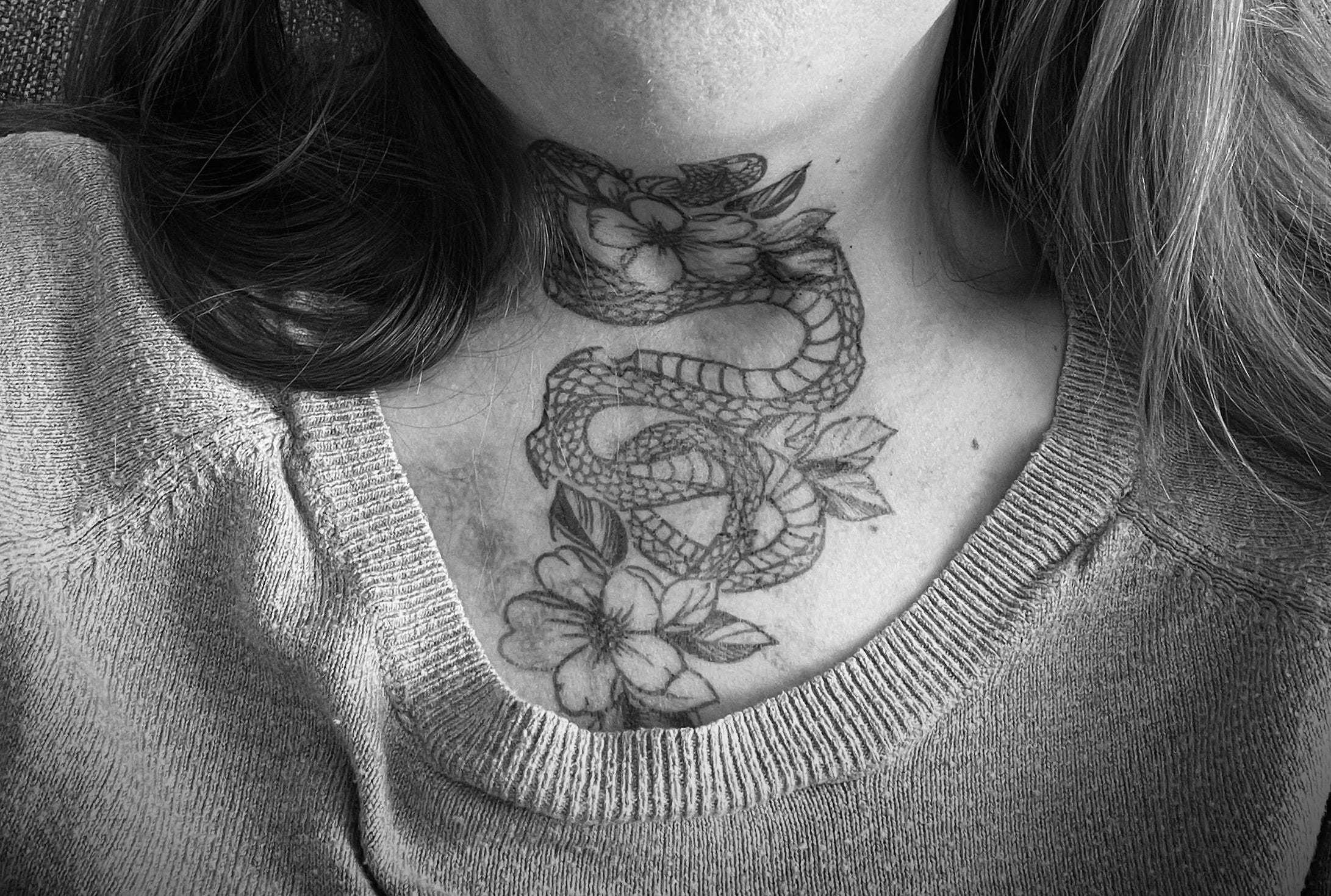
I'm sorry it took me so long to get to reading this piece. Thank you, Amy, for reminding us that our monsters are "sacred," meaning that they have their own bonafide existence. They are not meant to be slain or conquered, but to be given a voice, like all other parts of us. I can't tell you how much I love the idea of God trying to have the experience of being a woman as a rationale for "giving birth" to creation...and all its monsters.